By Jameson Mutua
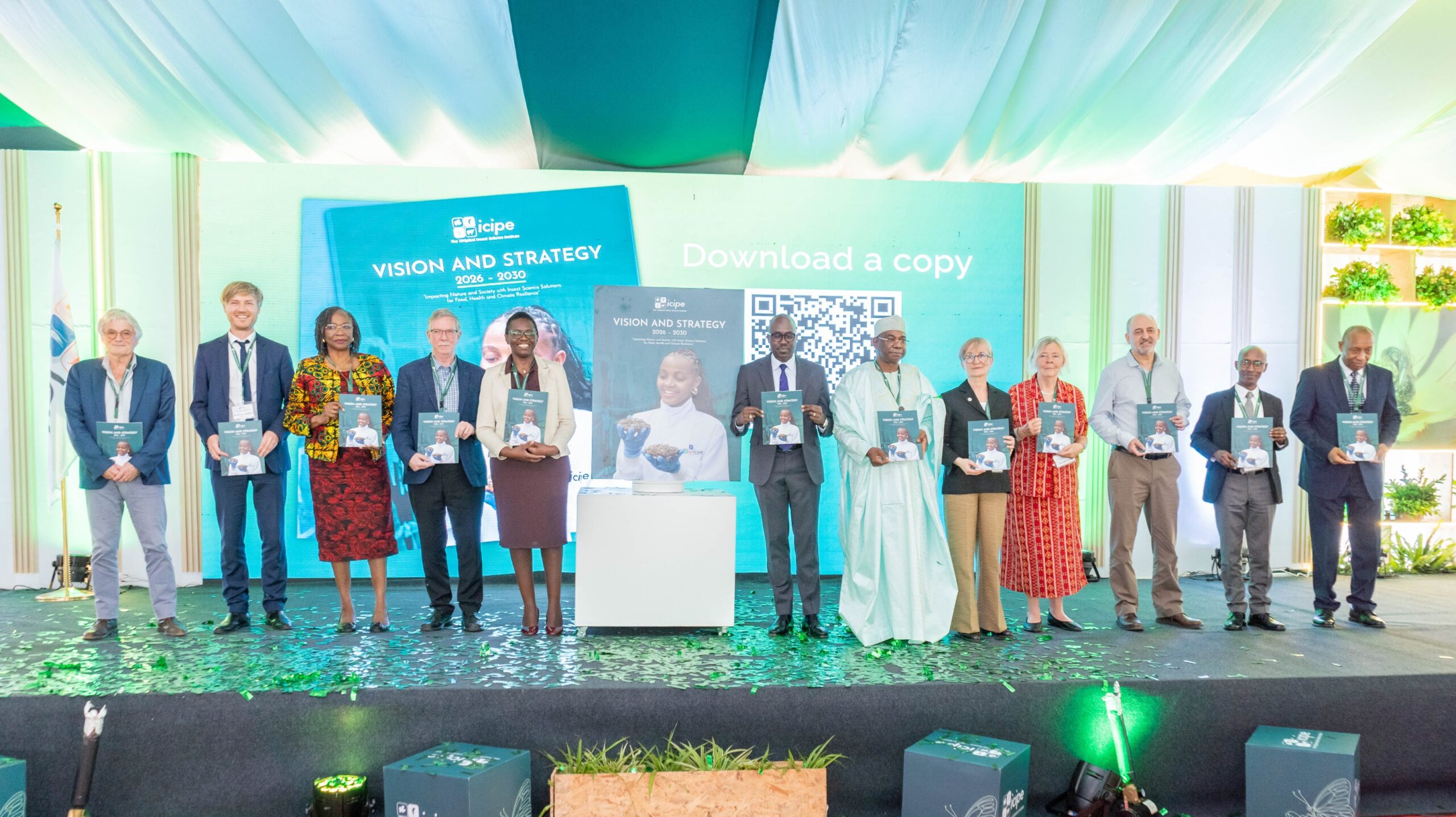
The International Centre of Insect Physiology and Ecology (icipe) on Friday launched its Vision and Strategy for 2026-2030, outlining a bold roadmap aimed at strengthening scientific leadership, boosting institutional excellence, and accelerating Africa’s transformation through insect science. The launch, held in Nairobi, brought together government officials, scientists, development partners, and members of the governing council.
Principal Secretary in the Ministry of Foreign and Diaspora Affairs, Sing’oei Korir, lauded icipe’s five-decade contribution to Kenya and the continent, describing the institution as a “beacon of scientific excellence” with a proven ability to convert research into practical solutions.
He celebrated icipe’s legacy, founded by the late Professor Thomas Risley Odhiambo at a time when Africa urgently needed home-grown scientific capacity.
Korir highlighted icipe’s role in tackling climate risks, biodiversity loss, food insecurity, poverty, and unemployment through innovative insect-based science. He also emphasised Kenya’s long-standing support for icipe, including granting land and special operational status to enable growth.
“To me, icipe stands as proof that Africa can bring her own solutions to her own problems,” he said, adding that the new strategy aligns with global and regional frameworks, including the Sustainable Development Goals, the Africa Union Agenda 2063, and President Ruto’s Bottom-up Economic Transformation Agenda.
icipe Director General Dr. Abdou Tenkouano said the launch marked the culmination of a 20-month internal journey that redefined the centre’s mission and values.
“This vision and strategy represent a united icipe that firmly believes in the principles guiding this roadmap,” he said. He recalled that the process began in June 2024 during a scientific retreat at the Mbita Point campus on the shores of Lake Victoria, a location he described as symbolic of icipe’s history and future direction.
Dr. Tenkouano said the new strategy signals “the beginning of a new era” rooted in heritage, strengthened by people, and driven by ambition to transform Africa through insect science. He thanked partners and stakeholders for their continued trust and support, saying their contribution remains central to the centre’s success.
icipe Governing Council Chair Dr. Ylva Hillbur said the strategy comes at a time when the global research landscape is experiencing disruption from rapid technological breakthroughs and unpredictable funding environments.
She said the roadmap will help icipe refine its scientific structure, strengthen institutional efficiency, and align with Africa’s and the world’s development priorities.
The strategy integrates icipe’s four core science themes – plant, animal, human, and environmental health – through a one-health lens, supported by research platforms in biosciences, data analytics, capacity building, policy engagement, and impact delivery. Together, these create a pipeline that links “laboratories to livelihoods, science to policy, and innovation to market.”
Dr. Hillbur noted that the document addresses five major impact domains: agri-food system transformation, global health, environment and biodiversity, climate adaptation and mitigation, and enabling policy environments.
She praised the collaborative and inclusive approach used in developing the strategy, commending Dr. Tenkouano’s leadership and the contributions of staff and stakeholders across all levels.
“These are exciting times for icipe,” she said. “The new strategy is a guiding light for the centre’s next chapter, grounded in a robust scientific foundation and strong institutional capacity.”
The leaders jointly expressed confidence that the 2026-2030 strategy will elevate icipe’s role in delivering innovative, impactful and scalable solutions that contribute to Africa’s sustainable future.