By James Mutua
The Nairobi Hospital has reiterated its financial stability, operational resilience, and continued delivery of quality healthcare services, dismissing recent claims that the institution is on the verge of collapse or in need of external intervention.
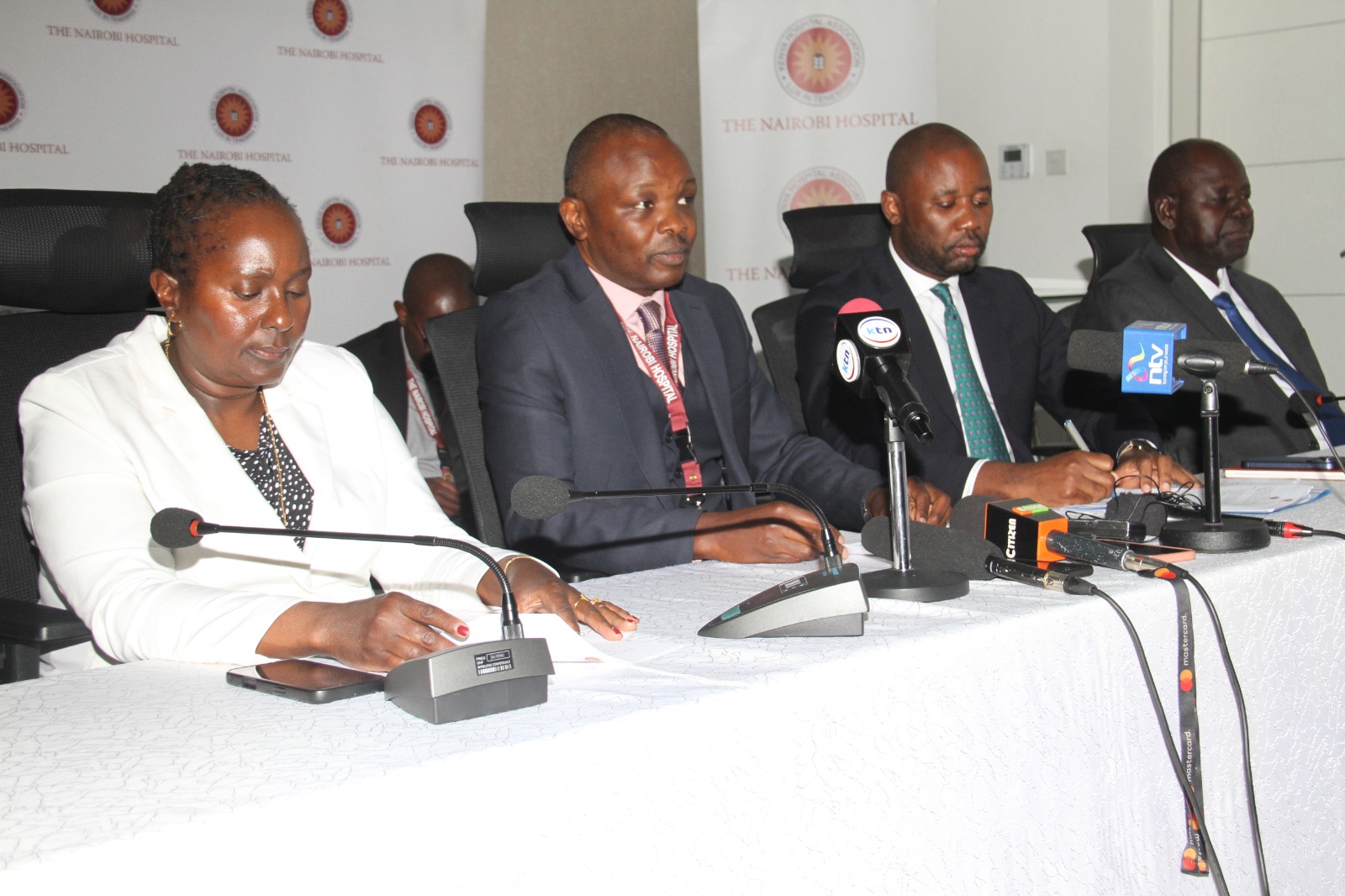
Speaking during a press briefing, Board Chairman Dr Barcley Onyambu and Chief Executive Officer Felix Osano presented verified financial and operational data showing the hospital remains stable, fully functional, and on a clear path to recovery.
“Our revenues stood at approximately KES 12.8 billion in 2024 and KES 11.8 billion in 2025, with the slight dip attributed to a temporary insurance suspension. Encouragingly, we are now seeing recovery, with monthly revenues stabilising at around KES 1.03 billion in early 2026,” said Osano.
Year-to-date performance further underscores this rebound, with revenue rising by 8 percent in early 2026 compared to the same period last year, alongside a KES 33 million surplus that reverses a previous deficit.
Operational indicators also remain strong, with patient admissions increasing by 5 percent, oncology services expanding by over 100 percent—largely driven by support to Kenyatta National Hospital under a Ministry of Health MoU—and bed occupancy improving to between 59 and 63 percent.
“These are not signs of an institution in distress, but of a hospital that is fully operational, serving patients, and strengthening its performance,” Osano added.
He dismissed circulating figures as misleading, clarifying that reports of a KES 4.2 billion loan are inaccurate and noting that the 2025 deficit has significantly narrowed to KES 815 million, reflecting improved financial management.
“The claim that KES 9.1 billion is missing is not factual. The audited position reflects a KES 2.214 billion deficit in 2024, largely due to legacy and one-off adjustments that have since been addressed. The hospital continues to meet its obligations while managing receivables, including KES 2.4 billion owed, mainly by public healthcare schemes,” he said, urging that public discourse be guided by verified financial data.
Dr Onyambu emphasised that the situation has been misrepresented as an institutional failure, whereas it is fundamentally a governance issue playing out publicly.
“The Nairobi Hospital remains stable, operational, and continues to provide care across all departments. What is being portrayed as institutional collapse does not reflect the reality on the ground,” he said, adding that the hospital is not facing a capability challenge but rather the misuse of governance mechanisms to advance narrow interests.
He reaffirmed that the hospital continues to operate within its established governance framework under the Articles of Association of the Kenya Hospital Association, noting that the role of Patron, traditionally held by sitting Presidents, is ceremonial and does not involve operational or governance decision-making.
The Board also raised concern over what it described as a pattern in which a small group of individuals uses litigation to stall governance processes, promote selective narratives externally, and disrupt operations for personal or commercial gain.
“This is not a position held by the broader stakeholder base, but a coordinated effort by a small group whose actions risk destabilising the institution,” Dr Onyambu said.
Despite these challenges, The Nairobi Hospital continues to play a key role in Kenya’s healthcare system, remaining fully operational, supporting national healthcare delivery through partnerships, and investing in advanced medical technology and international quality standards.
The Board and Management reaffirmed their commitment to safeguarding the institution’s integrity, upholding governance through lawful structures, and ensuring it serves the interests of all stakeholders.
“We will continue to execute our mandate responsibly and ensure the institution remains stable, credible, and focused on patient care,” Dr Onyambu concluded.
The Nairobi Hospital maintained that it remains operational and committed to transparency, unity of purpose, and the highest standards of patient care, while serving the interests of all stakeholders rather than a select few.