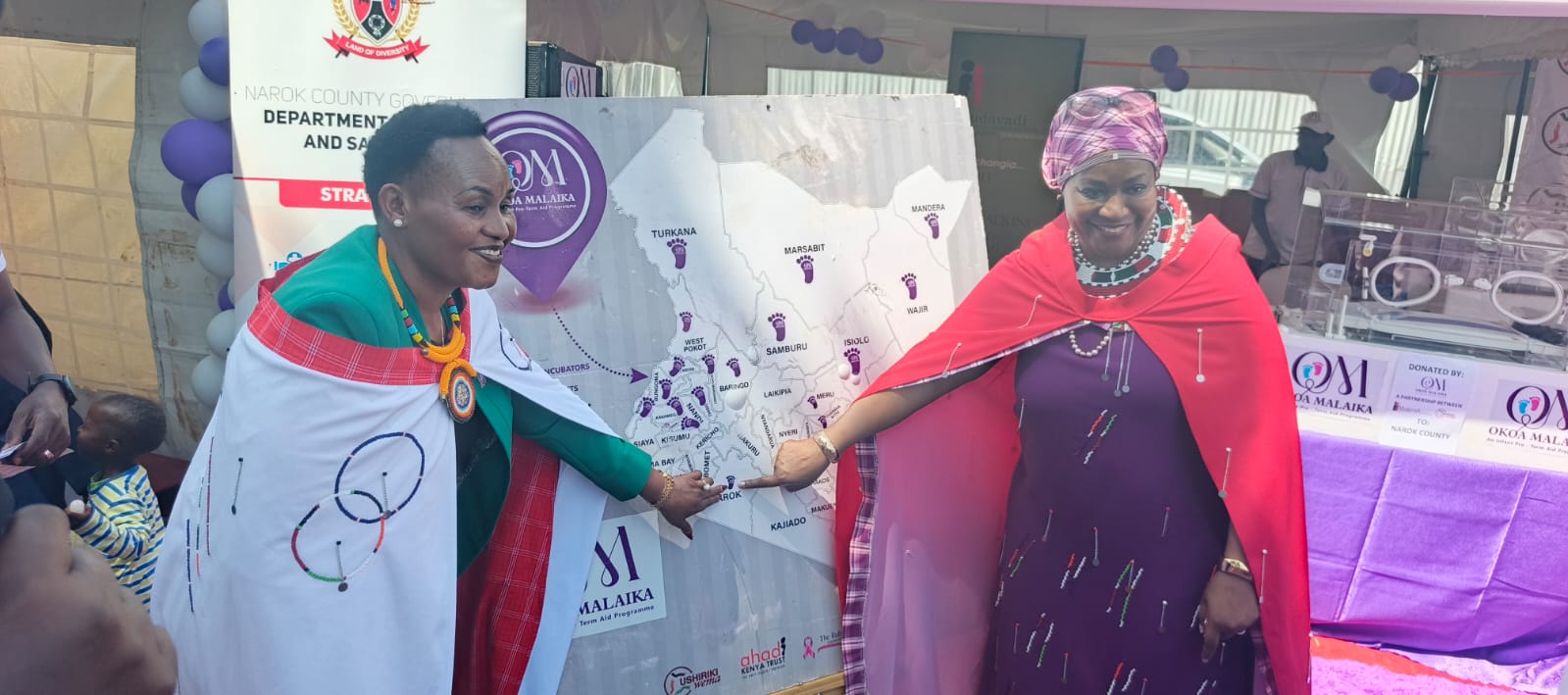
The Ushiriki Wema Foundation has expanded its Okoa Malaika programme to Narok, Kericho, Kajiado and Bomet counties, increasing access to lifesaving neonatal care for premature babies through the donation of incubators to public hospitals.
The latest expansion brings the programme to 32 public health facilities nationwide as Kenya continues to battle high rates of preterm births. About 134,000 babies are born prematurely every year, representing nearly 12 percent of all births. Around 42,000 of these newborns die annually, while many others suffer long-term health complications.
Speaking during the handover ceremony in Narok, the Foundation’s Patron, Her Excellency Madam Tessie Musalia Mudavadi, described the statistics as worrying and urged greater investment in maternal and newborn healthcare.
She said many premature babies die not because of a shortage of skilled health workers, but because hospitals lack essential lifesaving equipment.
“Behind many of these deaths is a gap in resources. Healthcare workers have the skills to save lives, but too often they lack the equipment they need,” she said.
Madam Tessie noted that the government has prioritized maternal and newborn health through the Kenya Every Woman Every Newborn Everywhere (EWENE) Acceleration Plan 2026–2028 and a KSh4.5 billion investment aimed at reducing preventable maternal and newborn deaths under the Universal Health Coverage programme.
She said the Ushiriki Wema Foundation is complementing these efforts by equipping hospitals with neonatal incubators, strengthening healthcare workers’ capacity and improving access to quality newborn care.
“Our goal is to ensure every mother receives quality care, every newborn gets the best possible start in life and every health facility has the equipment needed to save lives,” she said.
Okoa Malaika Programme Brand Ambassador Njoki Mambo said the initiative has remained true to the commitment it made on World Prematurity Day in 2023 to help reduce deaths caused by premature birth.
She said the programme’s expansion to 32 facilities marks significant progress in improving neonatal care across the country.
“When we place an incubator in a hospital, we are giving a baby born too soon warmth, protection and time to survive. Every incubator is a symbol of hope for families and healthcare workers,” she said.
Njoki added that visits to beneficiary hospitals have shown how the donated equipment is helping medical staff save more newborns.
Narok County First Lady Agnes Ntutu welcomed the partnership, saying continued investment in maternal and newborn healthcare would strengthen county health services, improve newborn survival and increase access to quality care.
The Ushiriki Wema Foundation said it will continue expanding the Okoa Malaika programme to more public hospitals to ensure every newborn, regardless of where they are born, has a better chance of surviving and living a healthy life.