Legal drafting is one of the most demanding aspects of legal practice. Whether preparing pleadings, legal submissions, affidavits, contracts or other legal documents, advocates must combine legal knowledge, research, precision and an understanding of the specific circumstances of each matter.
Traditionally, preparing these documents involves reviewing previous work, researching relevant legislation and case law, structuring arguments and repeatedly refining drafts before they are ready for use.
Artificial intelligence is beginning to change this process.
AI-powered legal tools are increasingly being explored as a way to support document preparation, helping legal professionals organise information, develop initial drafts and reduce the time spent on repetitive writing tasks.
However, the adoption of AI in legal drafting also raises important questions. Can generated documents accurately reflect Kenyan law? Are the legal authorities cited genuine? And how much professional review is required before an AI-assisted document can be relied upon?
These concerns are particularly relevant in a profession where inaccurate legal references, poorly structured arguments or unsupported propositions can undermine an otherwise sound submission.
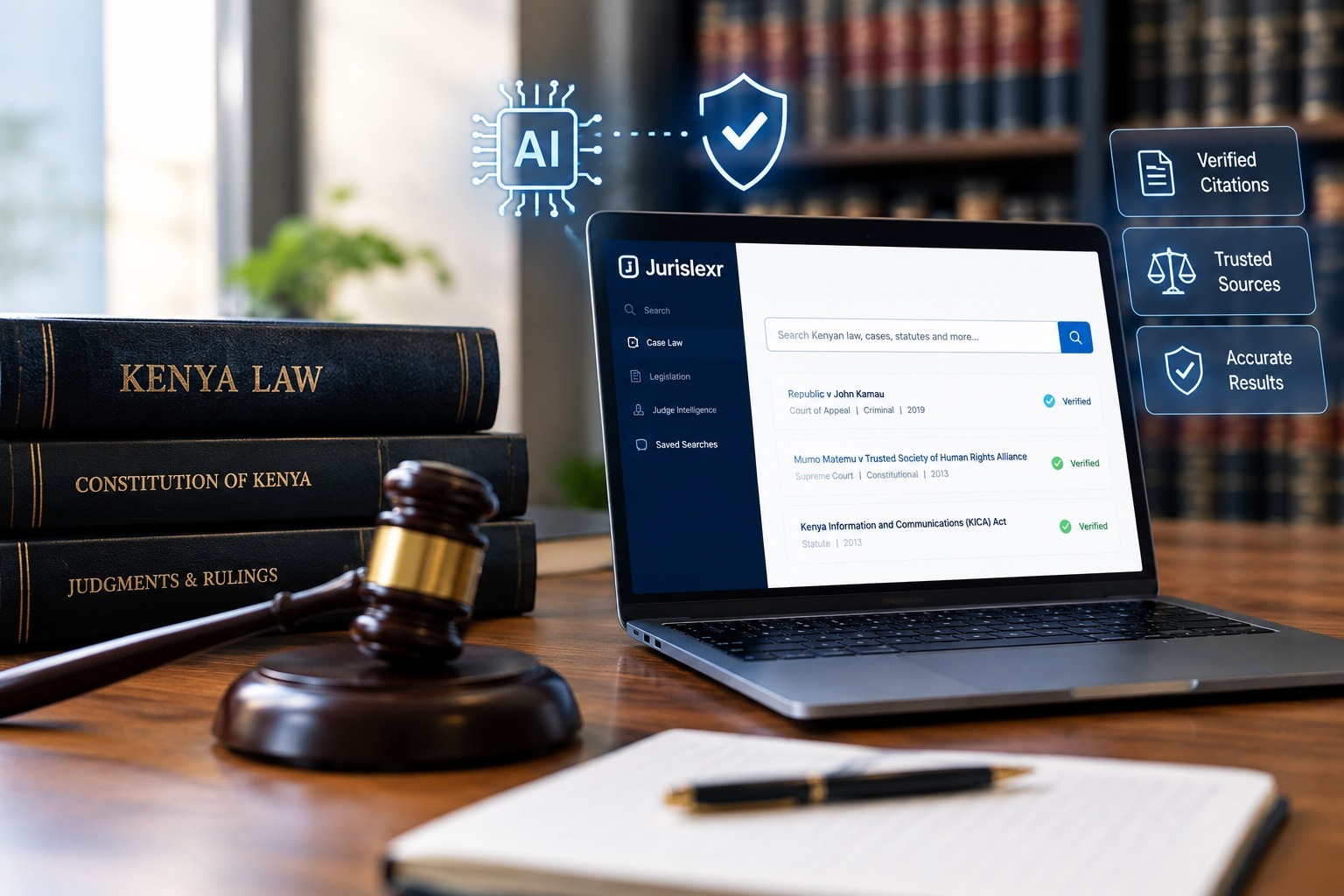
Jurislexr, a legal technology platform developed for the Kenyan legal market, is expanding its capabilities beyond legal research to include AI-assisted drafting.
The drafting functionality is intended to support legal professionals in preparing documents within their workflow, bringing research and document preparation closer together.
This development reflects a broader direction in legal technology: moving from tools that simply retrieve information to systems that assist with practical legal tasks.
Nevertheless, AI-generated drafts should be treated as working documents rather than final legal opinions. Advocates remain responsible for checking the accuracy of the content, verifying legal authorities, ensuring that arguments are supported by the relevant law and adapting documents to the facts of individual cases.
For law students and researchers, these tools also present opportunities to understand legal document structures and explore how research findings can be translated into written arguments, provided they are used responsibly.
As AI adoption grows within Kenya’s legal sector, the real measure of progress will not simply be how quickly a document can be produced, but whether technology can help improve the quality and efficiency of legal work while preserving professional judgement and accountability.