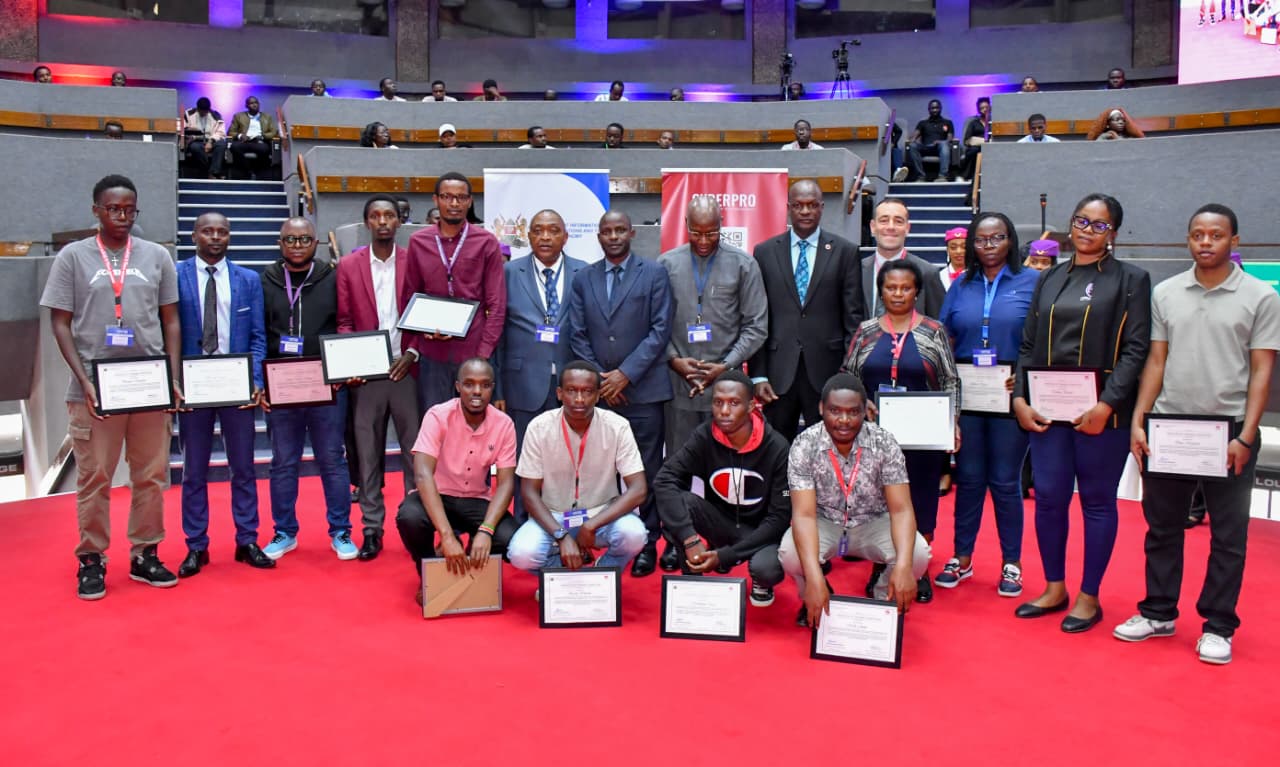
Cyberweek Africa 2026 ended on Friday with a call for stronger policies, advanced technologies and enhanced skills to help African countries address emerging cybersecurity threats in the age of artificial intelligence (AI).
The event brought together government officials, private sector players, academics, non-governmental organisations and start-ups to examine the growing threats posed by AI to critical information infrastructure, digital networks and online trust.
Participants also explored opportunities to harness AI in strengthening cybersecurity through appropriate policies, technologies and skills development.
The annual event was organised under the leadership of the Ministry of Information, Communications and the Digital Economy, in partnership with the Kenya School of Government, the Ministry of Interior and National Administration, the National Cybersecurity Agency and the University of Nairobi, among other partners.
It attracted more than 1,200 participants from 20 countries and featured a hackathon supported by Expertise France and the European Union (EU). In the run-up to the event, cybersecurity awareness sessions were also conducted in 21 institutions of higher learning across the country.
The opening ceremony was presided over by Principal Secretary for Broadcasting and Telecommunications Stephen Isaboke, National Cybersecurity Agency chairman Dr Martin Koyabe and Kenya School of Government Director-General Prof Nura Mohamed. EU Ambassador to Kenya Andreas Peschke and other diplomats also attended.
During the ceremony, Mr Peschke congratulated 19 Kenyans who had attained certification as SIM3 cyber auditors, while Tahar Benattia of Expertise France presented awards to the hackathon winners.
Huawei Kenya Country Cybersecurity and Privacy Officer Kaine Zhang, whose company was among the event’s major sponsors, highlighted the importance of building users’ cybersecurity capacity while providing secure products and solutions.
He said Huawei remained committed to supporting both areas as organisations seek to strengthen their digital security.
At the closing ceremony, 21 government ICT officers were recognised after completing a network training programme supported by Huawei.
Huawei Sub-Saharan Africa Regional Cybersecurity Expert Lu Hao also addressed the conference, presenting on the development of next-generation autonomous intelligent security operations systems.
He emphasised the need for integrated security solutions that connect different systems to provide comprehensive visibility, enabling organisations to prevent, detect and respond to cyber threats more effectively.
The event concluded with a declaration outlining actions participating organisations would undertake to strengthen information sharing and cooperation in addressing cybersecurity challenges.
Dr Koyabe underscored the importance of building trust among stakeholders to facilitate effective information sharing, noting that digital sovereignty should not be confused with digital isolation.
He called for stronger collaboration between regulators and industry players, including sector-specific regulators in industries such as financial services.
Cyberweek Africa 2026 was among the first major cybersecurity events held in Kenya since the establishment of the National Cybersecurity Agency, with Dr Koyabe’s participation highlighting the agency’s commitment to stakeholder engagement and collaboration.
Principal Secretary for Internal Security Jacob Narengo, who represented the PS for Internal Security and National Administration at the closing ceremony, said AI had become a powerful tool that could be used by both cyber defenders and criminals.
“AI is a force multiplier, both shield and spear. Threat intelligence is how defenders stay ahead, knowing about the attack before it strikes. AI can help defenders detect threats in seconds, or it can help attackers fake voices, craft convincing scams and target mobile money users,” he said.
He warned that while AI could strengthen resilience when properly harnessed, inadequate preparation could expose countries and institutions to greater cyber risks.
“Given preparation, AI multiplies resilience; but given neglect, it multiplies exposure. For Africa, expanding our digital ecosystem without hardening its defences means building our future on sand,” he said.
Mr Narengo also highlighted the importance of implementing the existing National Cybersecurity Strategy and AI Strategy, alongside the development of additional policy frameworks.
These include the Digital Policy, Cybersecurity Policy, Data Governance Policy, and AI and Emerging Technologies Policy, which are expected to guide the country’s response to emerging digital risks.