Commuters travelling from Nairobi’s Central Business District to Talanta Stadium will take about 15 minutes by train once the upgraded railway line is completed, Transport Principal Secretary Mohamed Daghar has said.
Daghar said the 13.3-kilometre Nairobi Central Station-Kibera-Talanta Stadium railway line was expected to be ready by December 15, ahead of the January 5 football match at the new Raila Odinga Sports City.
Speaking on Tuesday during an inspection of the project, the PS said the Government was upgrading the line to ease movement of thousands of spectators expected to attend major sporting events at the stadium.
He said Kenya Railways would be able to transport up to 1,500 passengers every 10 minutes in each direction during major events.
“We are going to be evacuating 1,500 passengers in every 10 minutes and bringing 1,500 fans in every 10 minutes to come and watch the game,” Daghar said.
The service will initially use diesel multiple units (DMUs), with each train operating eight coaches. Kenya Railways is also considering reducing the intervals between services to between five and seven minutes, depending on the final traffic management plan.
Daghar said the corporation had about 15 DMUs, 11 of which were operational, while the remaining units were undergoing refurbishment.
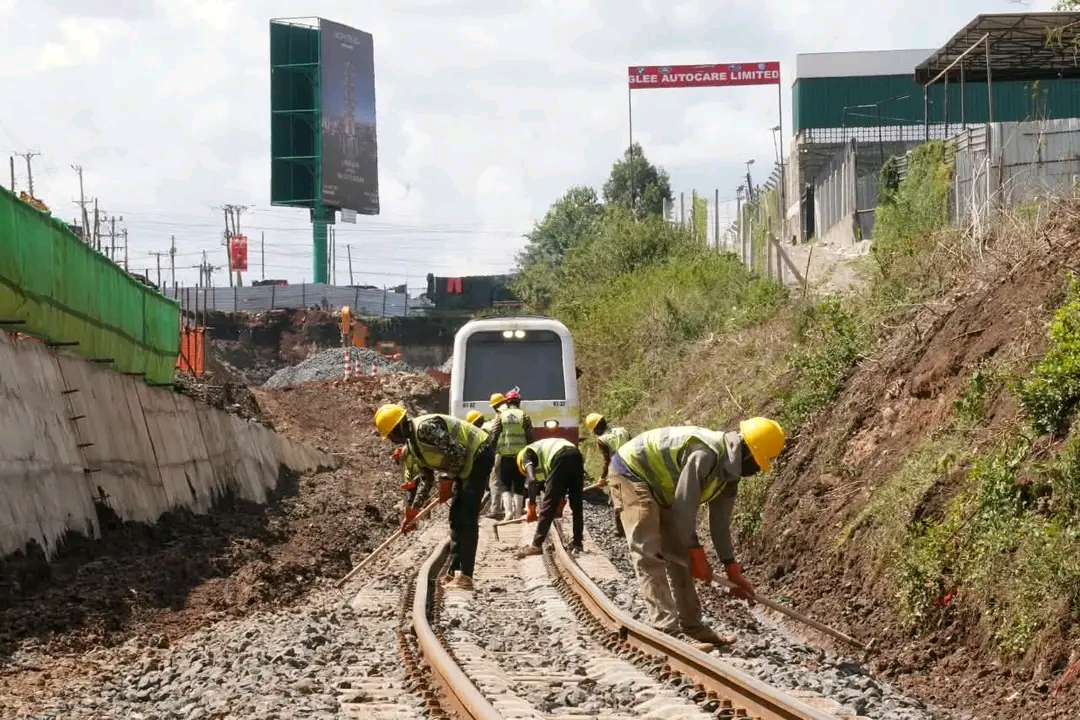
The upgrade involves rehabilitating the existing railway section, strengthening the track foundation, replacing old steel sleepers with 21,600 concrete sleepers and improving drainage along the corridor.
The works also include constructing a branch line from Kibera Station to the new Talanta commuter station, three pedestrian footbridges and a masonry wall.
The new station is being built near the stadium, with construction of its substructure already complete. Work on the superstructure is ongoing and is expected to be completed by the end of November.
Daghar said the upgraded line would improve commuter services for residents along the corridor, including those in Kibera, Laini Saba, Satellite, Kikuyu and Limuru.
The railway will also serve spectators travelling to Nyayo National Stadium, which is among the facilities expected to host matches during the Africa Cup of Nations (Afcon).
The PS described the Nairobi Central Station-Satellite section as the second-busiest commuter railway route in the Nairobi metropolitan area after the Ruiru-Thika line.
He appealed to residents to be patient as the ongoing construction has affected the frequency of existing commuter train services through Kibera.
Beyond the stadium project, the State Department for Transport is reviewing Nairobi’s 2019 commuter rail master plan and feasibility study as part of efforts to expand and integrate public transport across the metropolitan area.
Daghar said the revised plan would cover eight to nine commuter rail lines serving Nairobi and neighbouring counties, including Kiambu, Machakos, Kajiado and Murang’a.
The proposed network includes routes connecting Nairobi Central Station to Limuru, Thika, Syokimau and Embakasi, as well as a proposed link to Jomo Kenyatta International Airport.
The Government also plans to integrate commuter rail services with five existing Bus Rapid Transit (BRT) lines, road transport and last-mile connections to improve passenger movement across the city.
Two additional BRT routes, including the Outer Ring Road and Thika Road Line Two, are under construction and will also be considered in the integration plan.
On environmental concerns, Daghar said the Government was evaluating alternative railway technologies as part of efforts to reduce pollution in the transport sector.
He said a study was nearing completion to assess different locomotive options, including diesel-electric and other multiple-unit technologies.
“Transport is the biggest polluter in the country, and we are very cognisant of that fact. We are committed to greening our transport sector,” he said.
Daghar was accompanied by Kenya Railways Managing Director Philip Mainga, China Road and Bridge Corporation (CRBC) Kenya General Manager Yu Xiaodong and other senior railway officials.