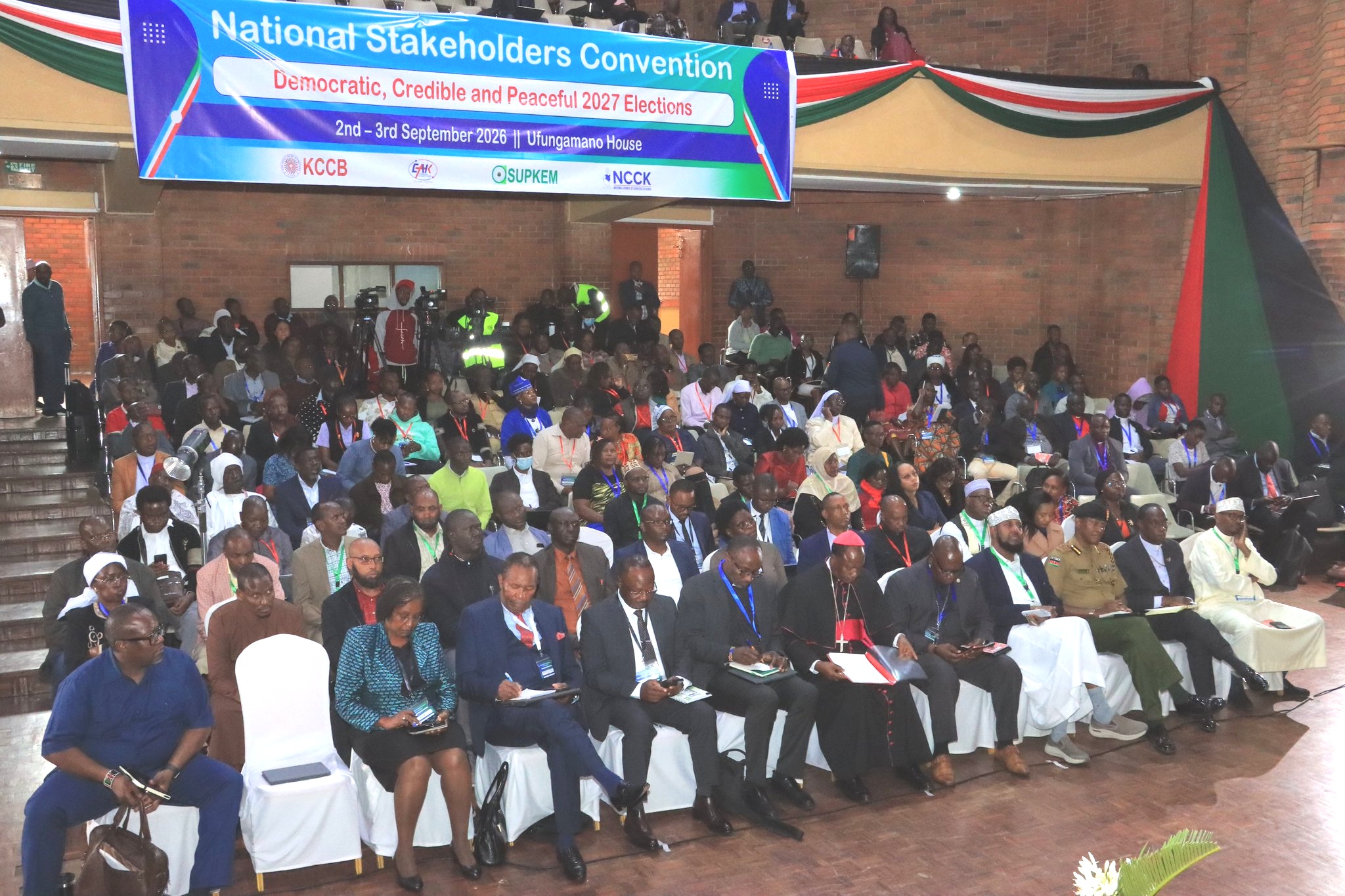
Religious leaders from the National Council of Churches of Kenya (NCCK), Kenya Conference of Catholic Bishops (KCCB), Evangelical Alliance of Kenya (EAK) and Supreme Council of Kenya Muslims (SUPKEM) have warned of rising political tension, violence, state capture and the misuse of money ahead of the 2027 General Election.
Speaking after a two day National Stakeholders Convention at Ufungamano House in Nairobi, the leaders said anxiety was growing over the possibility of election related violence, citing the 1997, 2007 and 2017 polls, which were characterised by violence, loss of lives and destruction of livelihoods.
The stakeholders identified five major risks to the 2027 electoral cycle: political violence and youth exploitation, institutional capture and abuse of state power, opaque campaign financing, misinformation and ethnic polarisation, and the exclusion of youth, women and persons with disabilities from leadership.
On political violence, the stakeholders accused political actors of sponsoring gangs and exploiting young people to perpetrate violence. They also raised concerns over what they described as selective policing.
The religious leaders committed to campaigning for the arrest and prosecution of individuals who finance political violence, warning that investigative and prosecutorial agencies would be held accountable if they failed to act.
The convention also raised concerns over the alleged capture of constitutional institutions and the growing influence of political donations to religious organisations.
The religious umbrella bodies said they would mobilise their members to restrict political access to religious platforms and promote anonymous giving in churches and mosques to shield faith institutions from political influence.
The stakeholders further warned that the monetisation of politics had reached a crisis point, with money allegedly influencing candidate selection, political competition, election outcomes and government decisions.
They committed to using places of worship to conduct civic and voter education while encouraging Kenyans to reject election bribery and illicit political financing.
The convention also expressed concern over misinformation, disinformation, hate speech and ethnic polarisation, saying political actors were increasingly using divisive narratives to portray sections of society as enemies.
The religious leaders pledged to promote messages that strengthen national cohesion and work with other stakeholders to establish fact checking mechanisms to counter false and misleading information.
On inclusion, the stakeholders said young people, women and persons with disabilities remained significantly underrepresented in leadership despite their numbers in the population.
They noted that people below the age of 35 account for about 75 per cent of the population but hold only four per cent of elected parliamentary positions. Women make up about half of the population but occupy 23 per cent of National Assembly seats, while persons with disabilities, who account for about 2.2 per cent of the population, hold about one per cent of elective positions.
The religious leaders pledged to use their institutions and wider social structures to support greater participation of youth, women and persons with disabilities in leadership and decision making.
They also called for a review of laws, policies and internal practices within religious institutions that may exclude the three groups from leadership.
The convention urged Kenyans to actively participate in political and governance processes, warning that violence, intimidation, abductions and other forms of repression could be used to discourage citizens from voting and engaging in public affairs.
The stakeholders also criticised the use of handouts during political campaigns, arguing that money distributed by politicians could come from stolen public resources or financiers seeking government contracts in return.
They called on Kenyans to reject election bribery and demand greater transparency in political financing.
In their conclusion, the stakeholders said Kenya faced serious risks ahead of the 2027 General Election and called for collective action to protect democracy, peace and constitutionalism.
The convention brought together representatives from six umbrella religious institutions, seven constitutional agencies, five professional bodies and 21 civil society organisations to assess the country’s preparedness for democratic, credible and peaceful elections.