By James Mutua
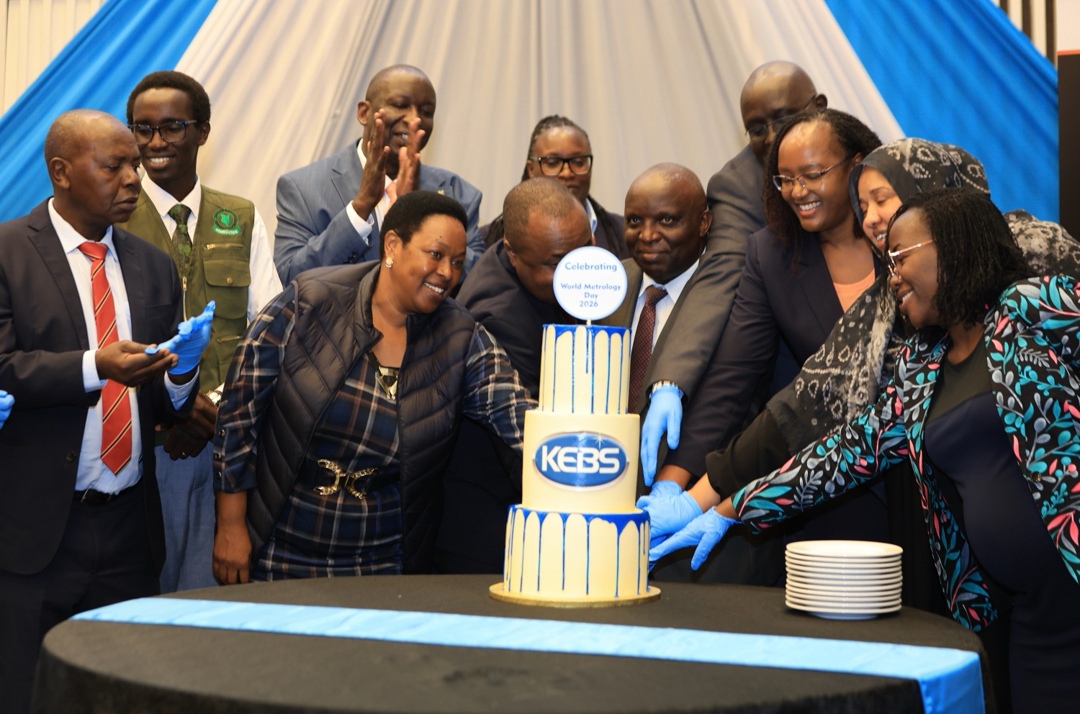
Kenya has reaffirmed the critical role of accurate and reliable measurements in shaping credible public policy, industrial growth, and public trust during the 2026 World Metrology Day celebrations organized by the Kenya Bureau of Standards (KEBS) in Nairobi under the theme “Metrology: Building Trust in Policy Making.”
Speaking on behalf of Principal Secretary for Industry Dr. Juma Mukhwana, Chief Industrialization Secretary Prof. Erastus Gatebe said trust remains the foundation of effective governance and can only be sustained through transparency, consistency, and reliable data.
Prof. Gatebe noted that every policy decision in sectors such as industry, health, agriculture, energy, and environmental protection depends on accurate and traceable measurements.
“When measurements are trusted, policies are trusted,” he said, adding that metrology continues to play a central role in Kenya’s industrialization agenda through institutions such as the Kenya Bureau of Standards.
He said the country must continue strengthening its national quality infrastructure in line with international best practices, especially as Kenya embraces digital transformation and innovation.
Chairperson of the National Standards Council Chris Wamalwa said metrology remains a cornerstone of credibility, fairness, innovation, and sustainable development.
Wamalwa illustrated the importance of accurate measurements through the story of a small-scale farmer from western Kenya whose export consignment of French beans to Europe was rejected after discrepancies emerged between declared and verified weights due to an uncalibrated farm scale.
“An entire season’s work was lost, not because of poor quality, but because of measurement error,” he said.
He warned that inaccurate measurements continue to affect markets, factories, clinics, and cross-border trade, emphasizing that trusted measurements are essential for sound policy, fair trade, and economic progress.
“In all these areas, policy must be guided not by assumption, speculation, or guesswork, but by evidence that is accurate, reliable, and internationally comparable,” he said.
Wamalwa added that metrology supports medical diagnostics, safeguards fairness in commerce, strengthens the competitiveness of manufactured goods, and enables reliable environmental monitoring and climate action.
He called for deliberate investment in laboratories, calibration and testing capabilities, modernization of legal metrology systems, and technical capacity building to ensure measurement science remains integrated into policymaking processes.
He also urged micro, small, and medium enterprises to adopt sound measurement practices to improve product quality, open markets, and enhance economic growth.
Managing Director of the Kenya Bureau of Standards Esther Ngari said the 2026 theme highlights the growing importance of trusted measurements in governance, trade, science, and regulation.
“Measurements build confidence, measurements build accountability, measurements build fairness, and ultimately, measurements build trust,” she said.
Ngari noted that this year marks 151 years since the signing of the Metre Convention in Paris in 1875, which established the global framework for measurement cooperation.
She said accurate and internationally accepted measurements remain critical in addressing modern challenges including climate change, pharmaceutical safety, digital trade, carbon markets, food systems, energy transition, and industrial competitiveness.
According to Ngari, metrology forms the invisible infrastructure that supports modern civilization by ensuring reliability in healthcare, fuel dispensing, exports, environmental monitoring, and evidence-based governance.
She said the African Continental Free Trade Area presents major opportunities for intra-African trade, but warned that trade can only flourish where countries trust each other’s measurement systems, testing, and conformity assessment processes.
“A kilogram in Nairobi must mean the same thing in Accra, Cairo, Kigali, or Cape Town,” she said.
Ngari added that the Kenya Bureau of Standards continues to strengthen Kenya’s measurement infrastructure across renewable energy, healthcare, advanced manufacturing, agriculture, digital technologies, and environmental sustainability.
She further noted that reliable measurements are essential in implementing Kenya’s Vision 2030 agenda, particularly in industrialization, climate resilience, universal healthcare, sustainable energy systems, and infrastructure development.
The celebrations brought together government officials, regulators, industry players, academia, development partners, and standards experts to reflect on the role of metrology in strengthening public confidence, fair trade, innovation, and sustainable economic development.
World Metrology Day is celebrated annually on May 20 to mark the anniversary of the signing of the Metre Convention in 1875, which established the International System of Units and global cooperation in measurement science. Metrology is the scientific study of measurement.