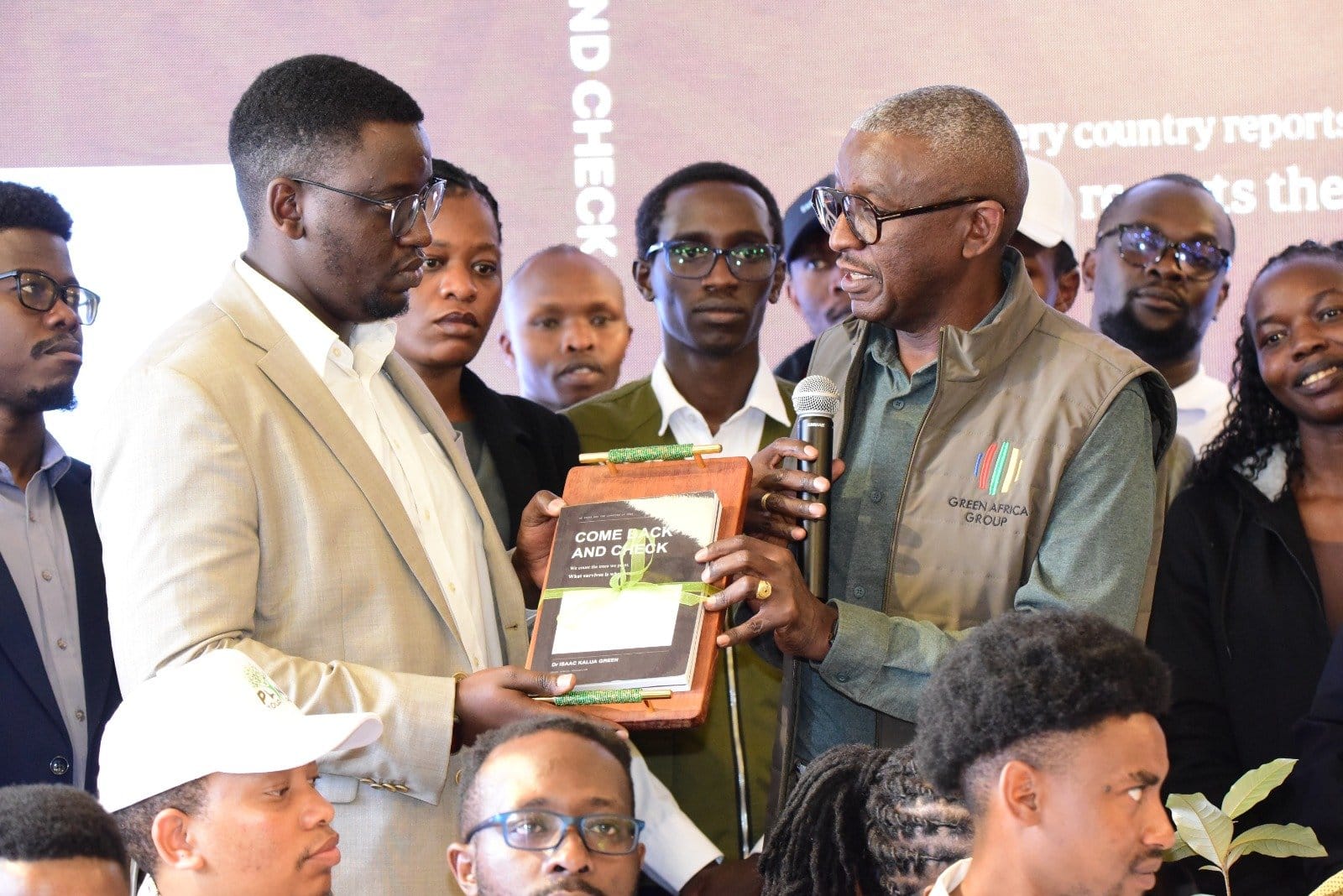
Environmentalist and Green Africa Foundation founder and CEO Dr Isaac Kalua Green has called for a shift in Kenya’s tree-growing campaign from counting seedlings planted to tracking how many trees survive and thrive.
Speaking during the activation of the Plant Your Age movement, Kalua said the country had for years focused on reporting the number of trees planted without adequately following up to establish how many survived.
Kalua said Kenya’s push to grow 15 billion trees must be anchored on accountability, proper planning and long-term care rather than the number of seedlings planted during tree-planting events.
“Do not count what you planted. Count what survived. Then come back and check,” Kalua said, outlining the central message of his new book, Come Back and Check.
He said the failure to monitor tree survival had undermined environmental programmes and made it difficult for financial institutions to develop credible financing mechanisms for green activities.
Kalua, who served as the inaugural chairperson of the Kenya Water Towers Agency, said he had personally visited several sites where trees had been planted only to find that there was little or no follow-up.
“We are excellent in reporting the number of trees that we are planting and there is no accountability. No one owns the tree,” he said.
He cited the Government’s 15 billion tree-growing campaign as an example of the need to change the approach, saying discussions had largely focused on the amount of money required to plant the trees instead of developing systems to ensure they survive.
Kalua said trees should also be viewed as economic assets capable of supporting livelihoods through food, medicine, energy and commercial products.
He cited sectors such as tea, coffee, avocado, mangoes and macadamia as examples of economic activities that depend on trees, arguing that environmental conservation and economic development should not be treated as separate issues.
“We keep talking about the tea sector, the avocado sector, we keep talking about macadamia. We are talking about trees,” he said.
Kalua also challenged Kenyans to take greater personal responsibility for environmental conservation through the Plant Your Age initiative, which encourages people to grow a number of trees equivalent to their age.
He said participants would contribute Sh57 for a tree-growing commitment, arguing that paying for seedlings could help create a sense of ownership while also supporting young people involved in tree production.
“Why should I give you a mango tree for free when it is you who is going to benefit out of it?” he asked.
Kalua said the Green Africa Foundation had documented an estimated 981 million tree-growing contributions since the launch of the Plant Your Age movement, while acknowledging the need for independent verification of the figures and survival rates.
He said the initiative had developed a framework based on seven questions to establish where trees were planted, who was responsible for them and whether they had survived.
“The story is here. I challenge the world to come with me,” he said, urging institutions and members of the public to scrutinise the records.
Kalua said the country could not rely on government funding alone to achieve the 15 billion tree target.
“The 15 billion trees will not be planted by the government. There is no money enough to do that. But those trees will be planted by us,” he said.
He urged Kenyans to embrace environmental conservation as a personal responsibility rather than waiting for government programmes or funding.
Speaking at the same event, environmentalist and Kenya’s 15 Billion Trees Campaign ambassador Hillary Kibiwott said the national target was achievable if Kenyans took ownership of the campaign.
Kibiwott, who holds a world record for growing 33,306 trees in 24 hours, said the Plant Your Age movement offered a simple way for individuals to turn personal milestones into environmental action.
“If I am 20 years, for example, I can grow 20 trees. If I am 30, I can grow 30 trees,” he said.
However, Kibiwott stressed that planting should only be the beginning, saying the success of the campaign should ultimately be measured by the number of trees that survive and continue providing benefits to communities and ecosystems.
“We must move from planting to growing. From numbers to survival and from one-day activities to year-round environmental stewardship,” he said.
He called on Kenyans to prepare early for the upcoming Mazingira Day by identifying planting sites, preparing land and securing seedlings before the rains arrive.
Kibiwott said his own conservation efforts since 2017 had resulted in more than 3.3 million trees being grown through community mobilisation, with a reported survival rate of up to 90 per cent.
He said his experience had demonstrated that long-term commitment and community involvement were more important than planting large numbers of trees during one-off events.
Kibiwott urged households, schools, institutions, faith-based organisations, communities and workplaces to take responsibility for growing trees and supporting the national campaign.
“The 15 billion tree-growing campaign should not be viewed simply as a government programme. It is a national programme,” he said.
He said achieving the target would require a change in mindset, with Kenyans asking what they could personally do to help grow the country’s 15 billion trees rather than focusing solely on what the government was doing.
The speakers said the campaign should ultimately focus on restoring degraded landscapes, protecting forests and water catchments, strengthening climate resilience, conserving biodiversity and securing a healthier environment for future generations.