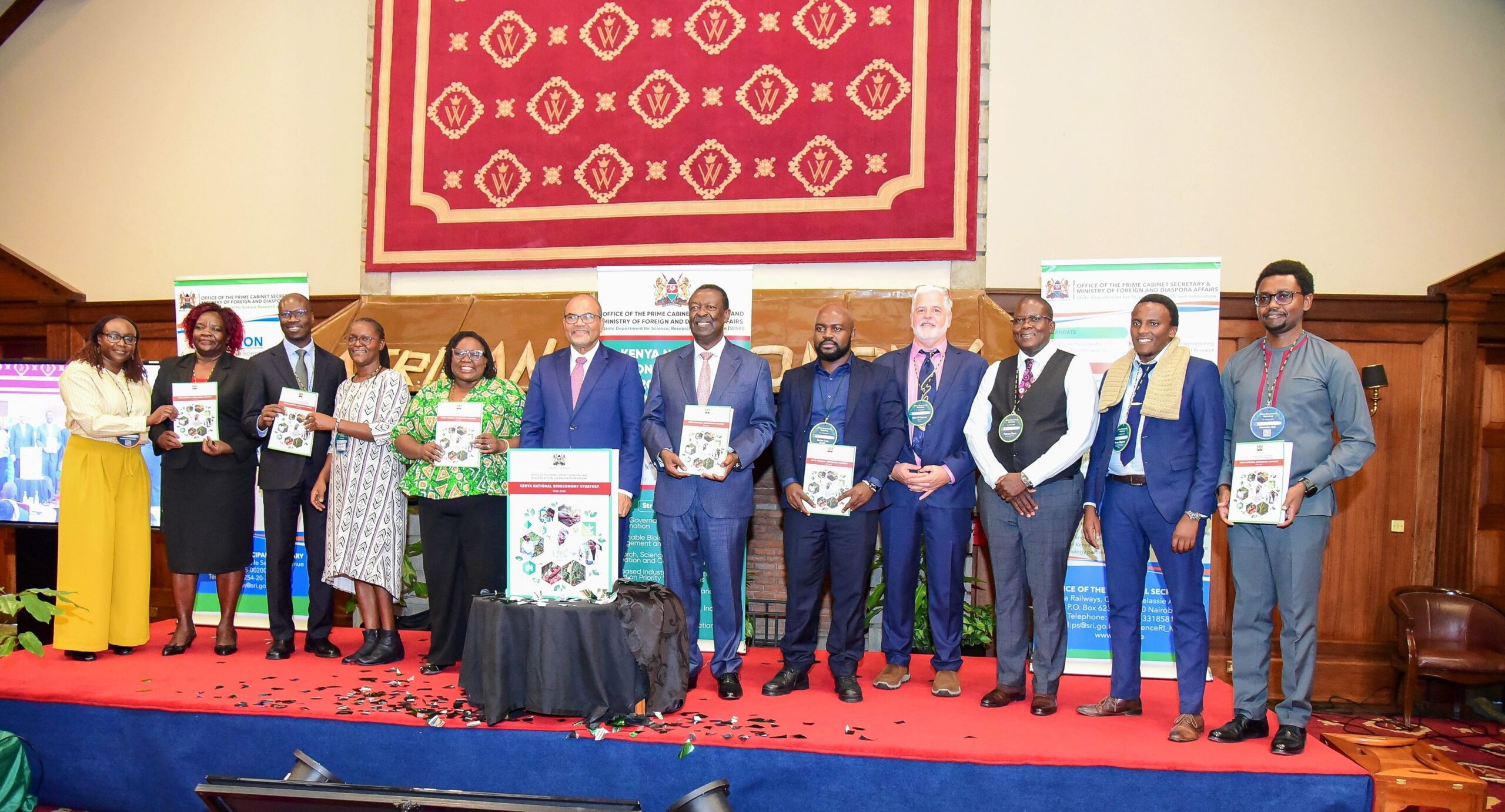
Kenya will on Tuesday launch its National Bioeconomy Strategy 2026–2036, a framework aimed at transforming the country’s biological resources into higher-value products, industries and jobs while strengthening research, innovation and investment.
Developed under the State Department for Science, Research and Innovation, the strategy seeks to strengthen the link between research and innovation, enterprise development, financing and markets, while promoting the sustainable use of biological resources.
Speaking at a media briefing in Nairobi on Monday ahead of the launch, Principal Secretary for Science, Research and Innovation, Professor Shaukat Abdulrazak, said the bioeconomy would play a central role in Kenya’s transition towards a knowledge- and innovation-driven economy.
“We are in that trajectory of moving this great nation of ours to a knowledge innovation-led economy and definitely the bio-economy in my opinion is going to be at the centre of all this,” Abdulrazak said.
He said Kenya must move beyond conducting research to ensuring innovations are commercialised and scaled up to create jobs, strengthen food security and expand the country’s wealth base.
Abdulrazak said the strategy would bring together academia, industry, government and society, describing the approach as a quadruple helix necessary to break institutional silos and strengthen collaboration.
He said the bioeconomy offered opportunities across agriculture, biotechnology, genomics, bioinformatics, engineering biology, industrial biotechnology, biomaterials and digital technologies.
The PS said Kenya must also use science and biotechnology to address food insecurity, climate change and food safety.
“It’s unacceptable, I always say this, 60 years down the line we are still food insecure. The science is there that can be able to help us,” he said.
Abdulrazak said the Government was targeting increased domestic financing for research and innovation, noting that Kenya currently spends about 0.78 per cent of its GDP on research.
He said the Government aims to raise this to at least one per cent and eventually two per cent, while mobilising at least Sh1 trillion over the next 10 years to support research, development, science, technology and innovation.
The PS raised concern that about 74 per cent of research financing currently comes from donors, saying greater participation by banks, financial institutions, foundations and the private sector was needed.
He also said the Government was working to strengthen the commercialisation of research through initiatives such as the Kenya Grand Challenge, which seeks to promote demand-driven research and solutions to societal problems.
Abdulrazak said the Government was also developing policies covering biosecurity, artificial intelligence for science, research and innovation, intellectual property and science diplomacy.
He said Kenya could position itself as a regional centre of excellence in bioeconomy by bringing together institutions working in areas including livestock, vaccine production, agriculture, forestry, environmental research and biotechnology.
“There’s no monopoly of knowledge,” Abdulrazak said, urging institutions to share expertise and work together to accelerate the country’s development.
The strategy also targets investment, with the Stockholm Environment Institute (SEI) saying the proposed framework seeks to mobilise Sh100 billion by 2036.
Niall O’Connor, Centre Director of Stockholm Environment Institute Africa, said Kenya was not starting a bioeconomy from scratch because biological resources already underpin a significant portion of the economy.
“Kenya’s bioeconomy is not new. It’s something that’s been here a long time and it’s developing,” O’Connor said.
He said the opportunity was to make the existing bioeconomy more productive, innovative, sustainable and attractive to investors.
Agriculture alone accounts for about 24 per cent of Kenya’s GDP and provides livelihoods for roughly 72 per cent of the population, while bioenergy supplies an estimated 68 per cent of the country’s energy demand, according to O’Connor.
He said activities spanning agriculture, fisheries, forestry, food processing, natural products and bioenergy could collectively account for about 40 per cent of Kenya’s GDP.
However, much of the value remains concentrated in primary production, with biological by-products and waste streams still underutilised.
O’Connor cited emerging enterprises that are converting biological resources into commercial products, including an entrepreneur manufacturing sanitary pads from banana plant fibre that would otherwise be treated as agricultural waste.
He said the national strategy could help address the gap between research and commercialisation by creating stronger links between researchers, entrepreneurs, investors and markets.
The strategy also targets opportunities in high-value food products, agricultural inputs, pharmaceuticals, nutraceuticals, biomaterials, sustainable textiles, insect-based foods, forest products and modern bioenergy technologies such as biochar.
O’Connor said financial institutions would need to develop financing instruments suited to the risks and longer investment periods associated with bioeconomy enterprises.
He also stressed that sustainability and equitable benefit-sharing must remain central to implementation.
“A bio-economy that depletes its resources, or excludes communities, cannot succeed,” he said.
SEI has supported Kenya’s bioeconomy development since 2016 and was involved in the development of the national strategy, with two of its experts serving on the Government-appointed technical working group.
O’Connor said the strategy would also strengthen Kenya’s position within the East African Community, where a regional bioeconomy framework calls on member states to develop national strategies.
He said Kenya could benefit from regional alignment through expanded markets, harmonised standards, cross-border value chains and stronger investment opportunities.
The strategy is expected to guide implementation over the next decade, with government, researchers, businesses, financial institutions and communities expected to play a role in turning Kenya’s biological resources into sustainable economic opportunities.